Chapter 1
Synopsis
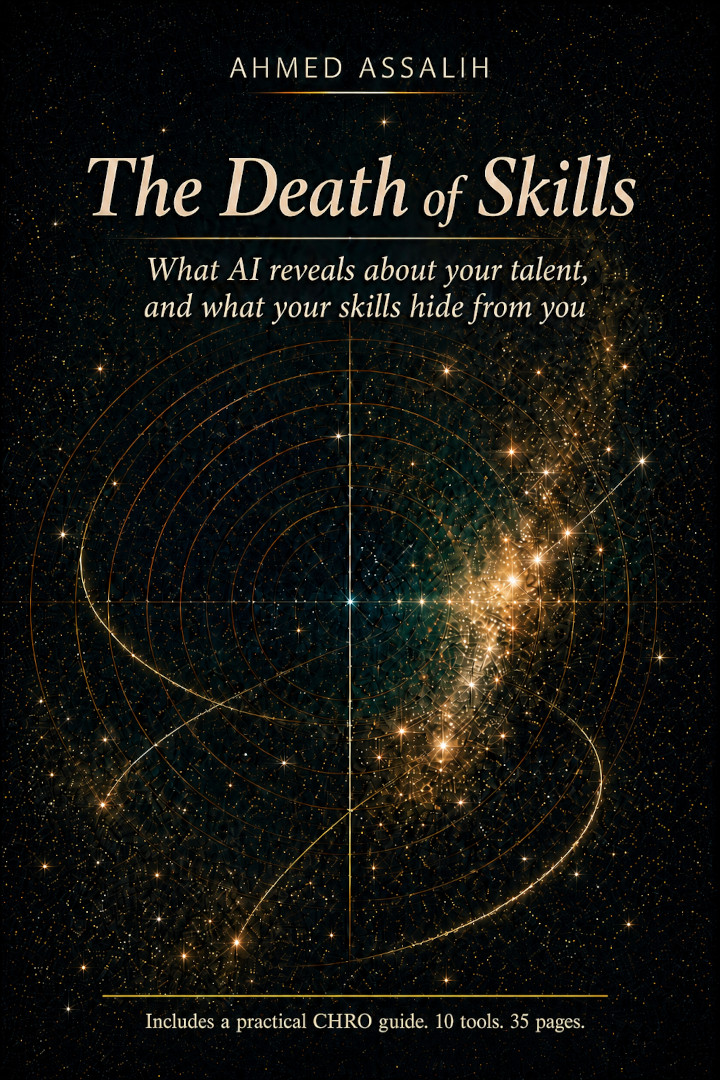
Generative AI is reshaping the substance of jobs every twelve to eighteen months. As it does, an employee's value shifts from the stock of skills they hold to the speed at which they acquire new ones. The instruments most organizations have built over the last two decades — skills frameworks, evaluation matrices, classification grids — measure a world that no longer stands still. And the function meant to steer this transformation, HR itself, turns out to be the least equipped to absorb AI even though it is the first arena where AI is being applied. That is the cobbler's paradox, and it runs through the entire book.
"The Death of Skills" does not predict the end of skills. It shows, methodically, why they can no longer serve as the sole lens for steering certain critical decisions. In their place, the book builds five operational frameworks designed for decision, not for contemplation. The Potential Stack reads potential beyond the skills inventory. Time-to-Skill puts a number on the cost of slow learning — a cost that stays invisible in AI investment plans. The Fortress, Front Line, Laboratory doctrine assigns each zone its own value regime. The Trajectory Radar tracks the movement of a career, not its frozen inventory. Pay-for-Agility rewards learning speed and its transmission, wherever they create value.
The book is structured in three sections and fifteen chapters. The diagnosis dismantles the blind spots of inherited tooling. The doctrine sets out the five frameworks and the architecture that supports them. The implementation works at the granularity of concrete practice, all the way to a full deployment case spanning 168 employees over nine months. An operational guide rounds out the whole, gathering ready-to-use tools: a paper-ceiling audit, an HR director's crash-test, interview grids, a pay-split method, a Pay-for-Agility calculator, and self-assessment routines for the HR function.
The book is written for the decision-makers who arbitrate the transformation of human capital. For HR directors who want to reclaim the doctrine rather than inherit it from vendors. For finance teams looking to provision the hidden cost of human latency. For executive committee members who must allocate, decide, and measure without delegating that judgment. And for HR Tech vendors, to whom the book also delivers a specification.
It is not a manifesto against experts, credentials, or technology. It is not a meditation on the future of work, nor a mass-market handbook. It is a work of clarification — drawing a line between what still holds, what must be protected, and what needs to be read differently. It offers distinctions, safeguards, zones where the technology should not be used, and a more rigorous way of connecting technology, organization, and human responsibility.
Structure
I. The diagnosis
Chapter 2
The HR Over-Engineering Complex
Chapter 3
The Expert Ceiling
Chapter 4
The Paper Ceiling
Chapter 5
Beyond the Nine-Box
II. The doctrine
Chapter 6
The Potential Stack
Chapter 7
Time-to-Skill
Chapter 8
The Boundaries of the Model
Chapter 9
From the Skills Catalog to the Trajectory Radar
Chapter 10
Recruiting the Trajectory
III. The execution
Chapter 11
Pay-for-Agility
Chapter 12
The Cobbler's Paradox
Chapter 13
The Crash-Test
Chapter 14
The First Deployment in a Bank-Insurer
Chapter 15
The Leadership of Uncertainty
The five operational frameworks
Potential Stack
Reading what a person can become, where conventional grids only see what they already know.
Learn moreTime-to-Skill
The metric that puts a price on slow learning — the cost that stays invisible in every AI investment plan.
Learn moreFortress, Front Line, Laboratory
Three postures for deploying AI where it creates value — without forcing it into zones where it creates danger.
Learn moreTrajectory Radar
Reading the movement of a career, not the frozen stock of skills a résumé captures.
Learn morePay-for-Agility
Paying for learning speed and its transmission — where conventional pay grids let rare profiles slip away.
Learn more